Here's part 2 of my 2018 visit to the battle of Wagram Museum - the dioramas....
Everything is 1/72 scale and units are at 1:1 ratio. Fantastic!
15mm, 1/600, 1/300, Wargames Figures - Conversions, Paintings, Scratchbuilds. Tumbling Dice, Doms Decals, Heroics + Ros, Baccus. BBB Rules.
Here's part 2 of my 2018 visit to the battle of Wagram Museum - the dioramas....
Everything is 1/72 scale and units are at 1:1 ratio. Fantastic!
Over Christmas I finished off most of my bridges, as described earlier in this post - Bridges 1 and got them table ready. I've added some rivers and troops for effect:
1. Bridge in good condition.
Napoleon views his troops as they cross the river.
The same scene with a "hasty bridge" - created by your engineers and sappers from whatever was to hand.... handy for crossing the Berezina!
I wanted some buildings for my Napoleonic games and so decided to construct a barn. A trawl of the internet found a blog on German buildings (Yes!) with lots of pictures of buildings both preserved, in use as barns and converted to something else. You can check out the blog here German Barns by Maggie Blanck I can only recommend it as inspirational.
I built the barn from card (using white glue) which I then covered in brick plastic card (super glued to the card). For walls and roof I used N gauge brick wall and tiled roof sheets from Slaters Plastikard. The roof was shaped from card and covered with tiles plasticard. I added framing from plastic rod and added doors. The barn was based on mdf from Warbases and painted with GW Citadel paints.
This barn is not based on one particular example, it is an amalgam of buildings to give the effect I wanted.
I'll also mention Jim Bibbly blog and Dan Hodgson Reveille Painting who regularly post pictures of their really attractive and detailed model buildings. Their work inspired me to give it a go!
So, here is the finished barn, next to some BBB based Austrians (on 1" x 1" bases).
The barn probably needs some magnetic strip underneath, both to give it a bit of weight and to raise it so the ground level matches the troop bases. It also needs a bit of grass!
Rivers and Bridges are often a key part of the battles that we fight as Wargamers, I have wanted to have some suitable bridges for my war-games that look good both with and without troops.
My main Napoleonic interest is the battles of 1809 in the Danube valley and in Italy. In particular, I want bridges for Ebelsberg (3 May 1809), Linz-Urfahr (17 May 1809), Sacile (16 April 1809) and Piave (8 May 1809). The first two require wooden bridges and the Piave requires a burnt bridge. I also fancied making a "makeshift" bridge for the Berezina river crossing of 1812. I reckoned that some interchangeable bridges, spanning a 2" wide river (for major rivers in BBB) would have many uses.
I searched the internet high and low to come up with these bridge pictures...
Ebelsberg
There are some issues with this picture. The Austrians are wearing Kasket hats that were replaced in 1798 by Raupenhelm (and were being replaced again in 1809 by Shakos). The French are wearing Bicorne - correct for the Tiralliers du Po, but their uniforms would be all blue...
Having said that, it is Austrians trying to destroy a wooden trestle bridge, whilst being charged by the French (or Italians!).... so the story telling bit is correct.
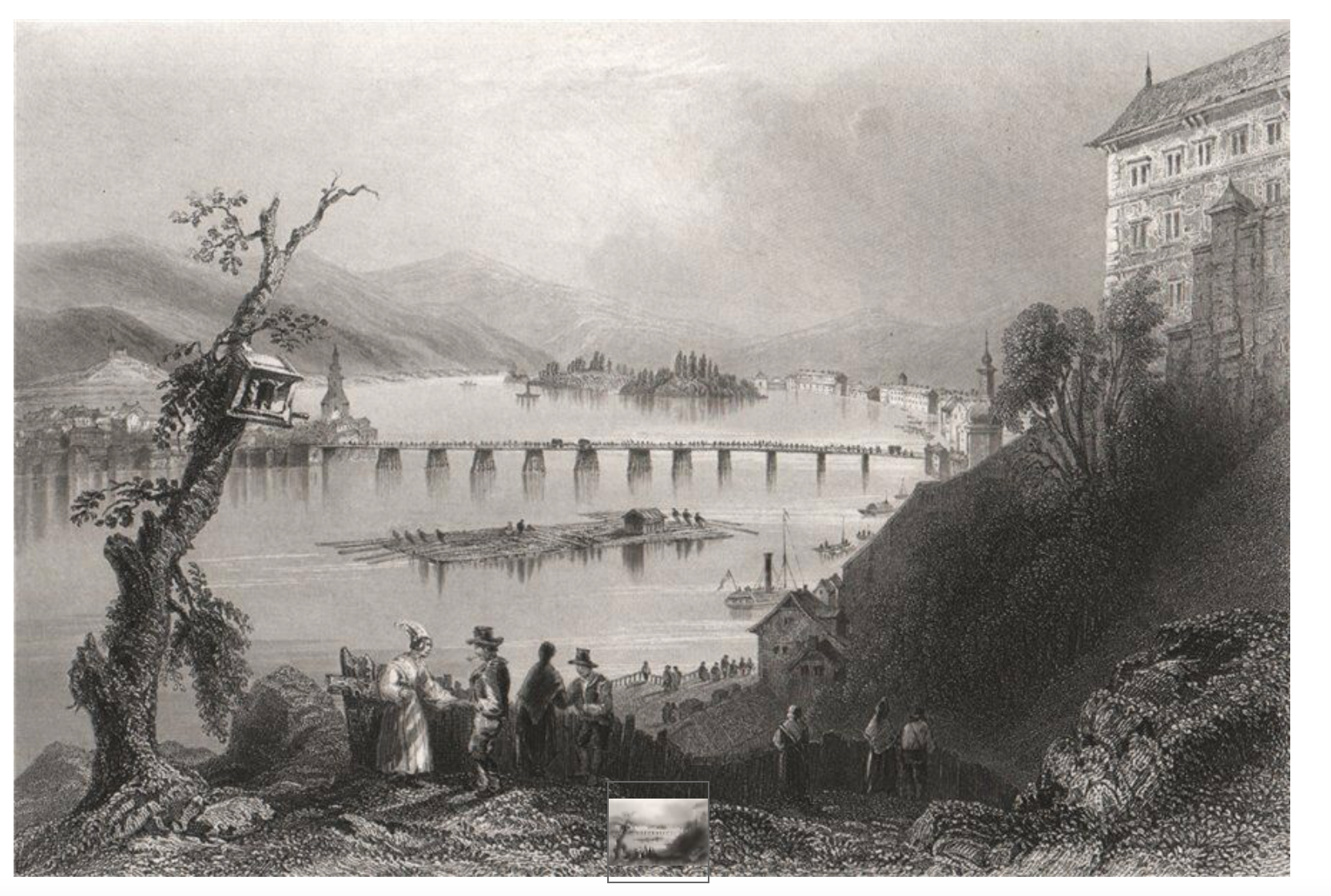
Linz
Landshut
Vienna (Tabor bridge, destroyed in 1809 as the Austrians left)
So what I need is a bridge mounted on wooden trestles, with a planked deck and side rails, with approach ramps either side. I base my troops on 1" wide bases, so the bridge deck needs to be 1.25" so the troops can be on the bridge. The base needs to be 1.5" wide by 2". I used Slaters 0.5mm plastic card for the deck and chopped up sections from the 2A04 N gauge white line side fencing kit to provide rails and trestles.
Here are the models to date:
2 completed bridges with side rails and abutments. The bridges are not stuck to the trestles, I need to paint the river under the bridge first...
Ship Mills were an ingenious idea to harness water power by making a catamaran, with the central well containing a water wheel. These could be moored to catch the strongest flow of the river and avoided having to build dams, weirs etc. associated with land based mills. These mills were first recorded in 6th century Italy and were common from the middle ages to the 19th and early 20th century in Europe.
Their military use was two-fold. They could be used as the basis of a pontoon bridge by lashing them alongside each other. They could also be used as battering rams to break up bridges down stream - as used by the Austrians who sent a series of ship mills into Napoleon's pontoon bridges over the Danube during the battle of Aspern-Essling.
They are usually represented as an off table factor and you don't often see them modelled. Chris Pringle had mused awhile ago BBB Blog - Ship Mills that they would be a fun thing to have. He donated a number of wargaming things to me earlier in the year, so I thought I'd make one as a way of saying thank you.
Research:
Here are two of the plans I found on the internet:
As you can see, it is not the most seaworthy of craft. Colours appear to have been black for the boat parts and light grey for the superstructure. My guess is that the hulls were painted with tar or pitch to make them waterproof, the superstructure would be weathered wood. The paddles seem to have been black.
Construction
I based the model on 2mm mdf, with a cut out in the middle for the wheel if needed. The hulls were coffee stirrers, shaped to the hull profile and with scribed planking. The sides and superstructure were card. The paddle blades were too short and thick on the first paddle, so I started again with a card/plastic tube metal washer combination. Various ribs and struts were added to give a bit of interest. It was undercoated with GW primer and painted with GW Acryllics. I painted on the water and little waves to give some idea of the mill pushing against the river flow.
photos:
The finished article:
I have not really done water before, I'm quite pleased with the result. If you have a go, consider making the sides of the pontoons in 0.5mm plastic (I used 1mm card) and if you had a wheel from a Mississippi stern-wheeler, that might work well. I reckoned that as these were widespread during the Napoleonic and 1848/49 Hungarian wars, Chris will get to use it quite often, so a little chunkiness and resilience in the wheel would not go amiss.
All in all a fun little model to build, it did not take long and was well received by Chris when handed over!
As ever, I hope this encourages yo to have a go at making your own terrain.